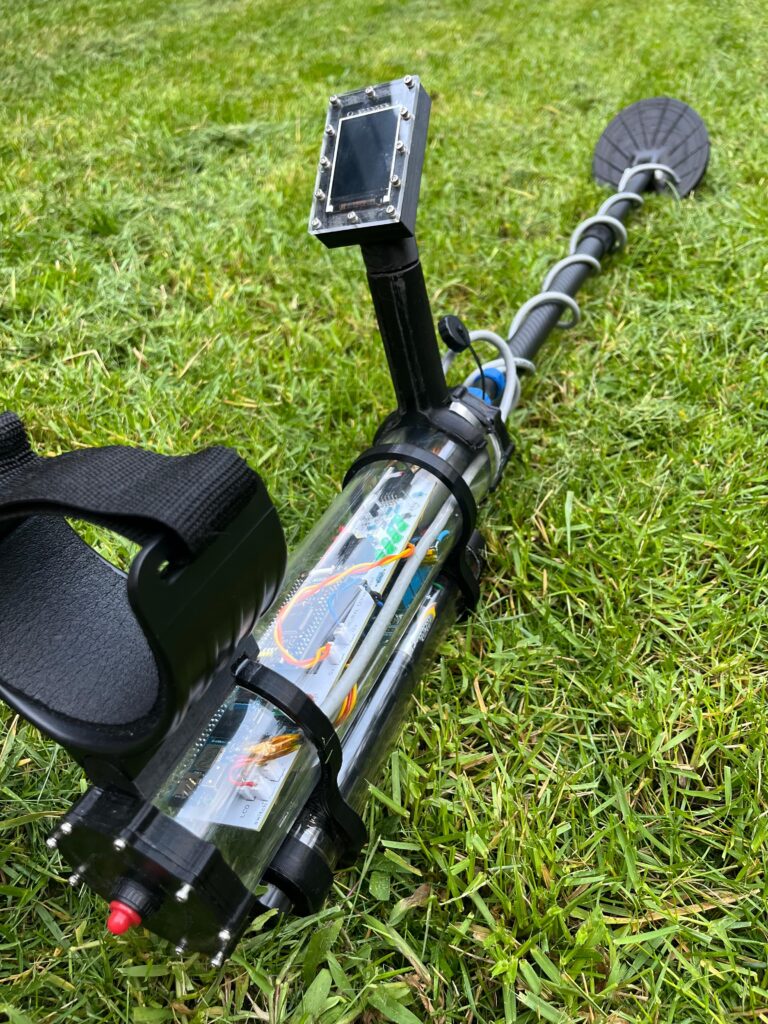
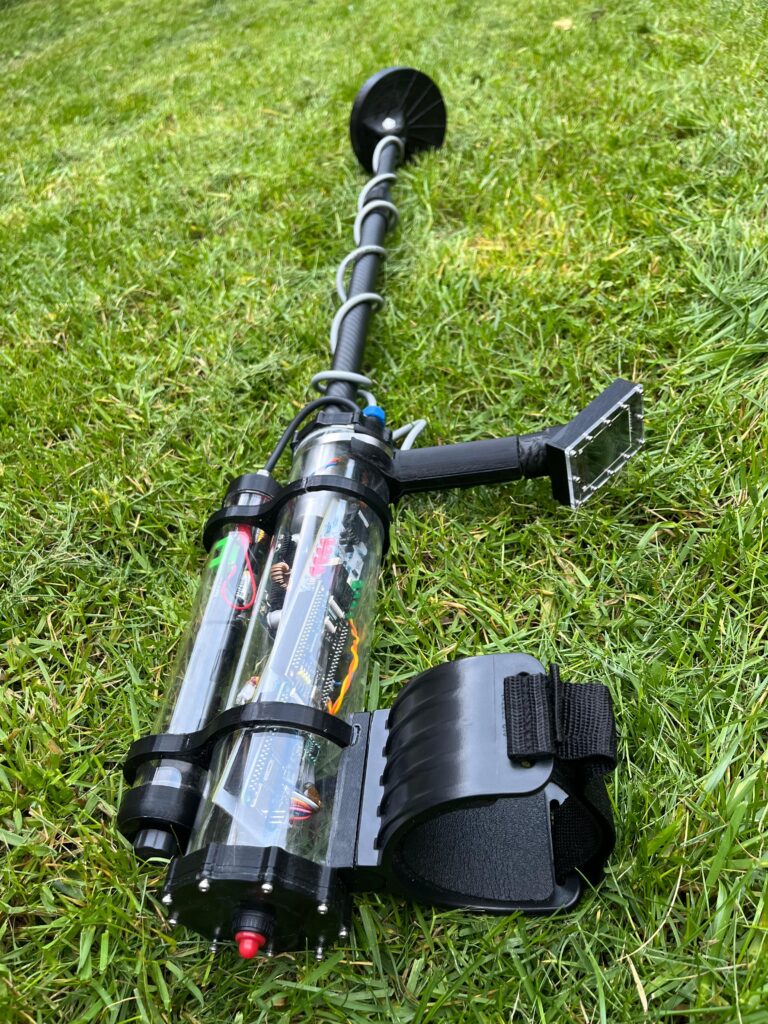
A new scenario for metals research, a modular and fully manageable system for difficult soils and conditions.

Many problems solved:
Too much dirt in the Soil, harsh conditions, Sea Water. These are the most common problems to face during research…
During the design of the prototype, attention was focused on the most “annoying” aspects of gold prospecting; however, not only on these. The goal was to develop a functional and adaptable model, capable of supporting various types of research, not exclusively gold-related.
The focus was placed on the discrimination and classification of metals, with the aim of developing an alternative method: a system capable of “learning” by generating a true memory of the targets to be identified.

The coils: a fundamental element of the system!
An attempt was made to design and size high-efficiency discrimination coils, starting from DD and Butterfly coils and developing a hybrid coil.


experimentation and testing

ADC and signal conditioning

PCB test

PCB, positive bias

Signal generation
WHY NEURAL?
As of today, neural networks are employed in a wide range of applications and are rapidly spreading across many domains. At the current state of the art, metal detecting systems that integrate neural networks already exist; however, after conducting extensive research, I did not find any product that is actually available or publicly documented. For this reason, I decided to design and develop my own system.
The system in question is a hybrid analog/digital architecture and integrates non-traditional multi-frequency technologies: the frequencies are not generated simultaneously, as in conventional systems, but through controlled pulse generation. The acquired signal is then processed via analog-to-digital conversion (ADC), enabling DSP processing and the subsequent extraction of relevant features, which are used in both the training and inference phases of the neural network.


Training of Neural Network:
- The results obtained during the training phase are highly promising; the system is capable of effective discrimination under laboratory conditions.
- This prototype stands out from traditional metal detectors due to its learning capability: it is trained directly by the end user according to the operational environment and target objects.
Features: Fraquency, amp, Phase.

1D CNN underwater Metal Detector with non-ferromagnetic discrimination
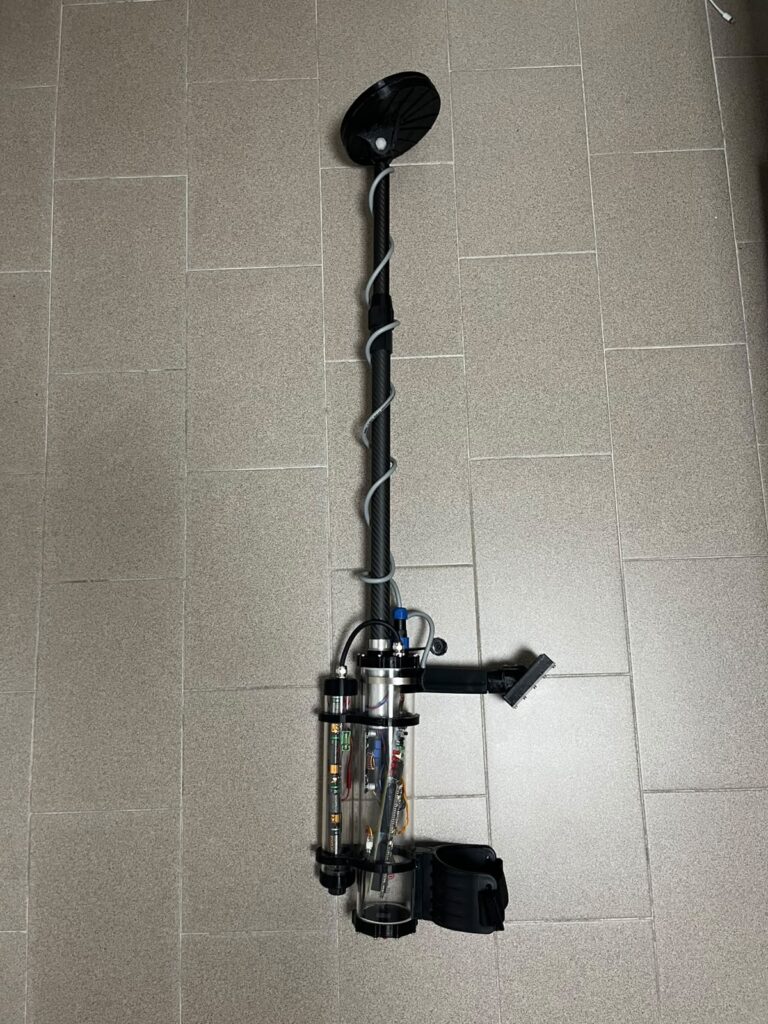
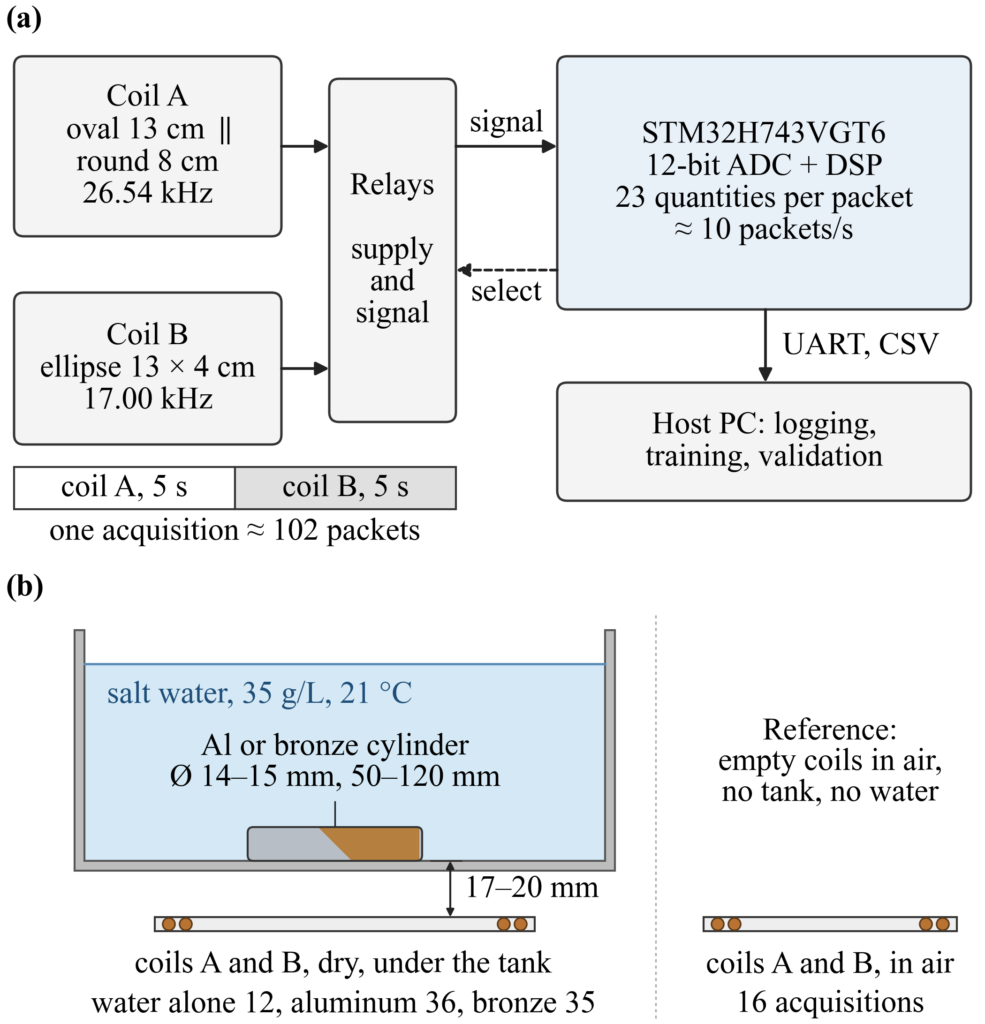
Two coils switched by relays, free-running at 26.5 kHz and 17 kHz
What has been measured
The hardest test I could think of: bronze against aluminium, with the target lying in salt water at full sea strength (35 g/L).
The two metals are non-magnetic and differ mainly in how well they conduct, which is exactly where ordinary discrimination gives up. And salt water conducts too, so the water answers the coil along with the target.
Twenty cylinders, ten of each metal, 83 independent placements. Judged only on placements it had never seen before, the machine named the right metal 89 times out of 100.
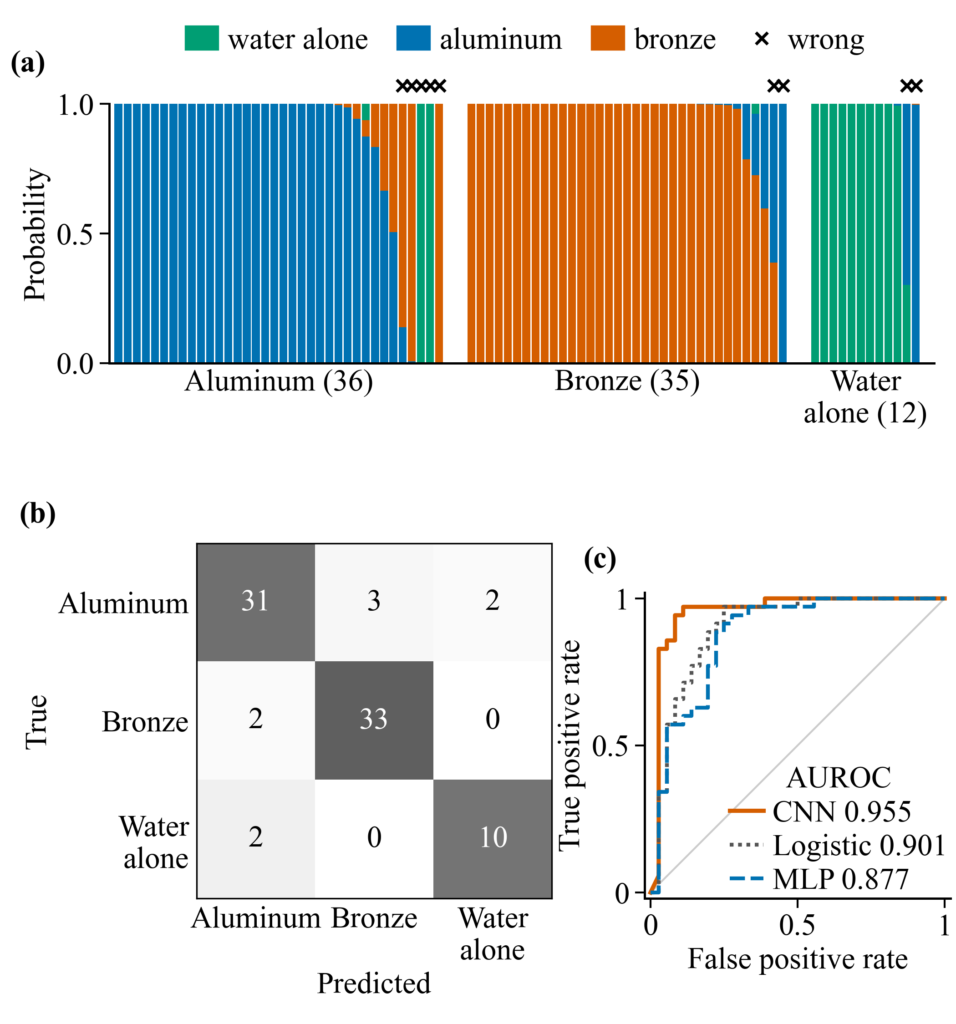
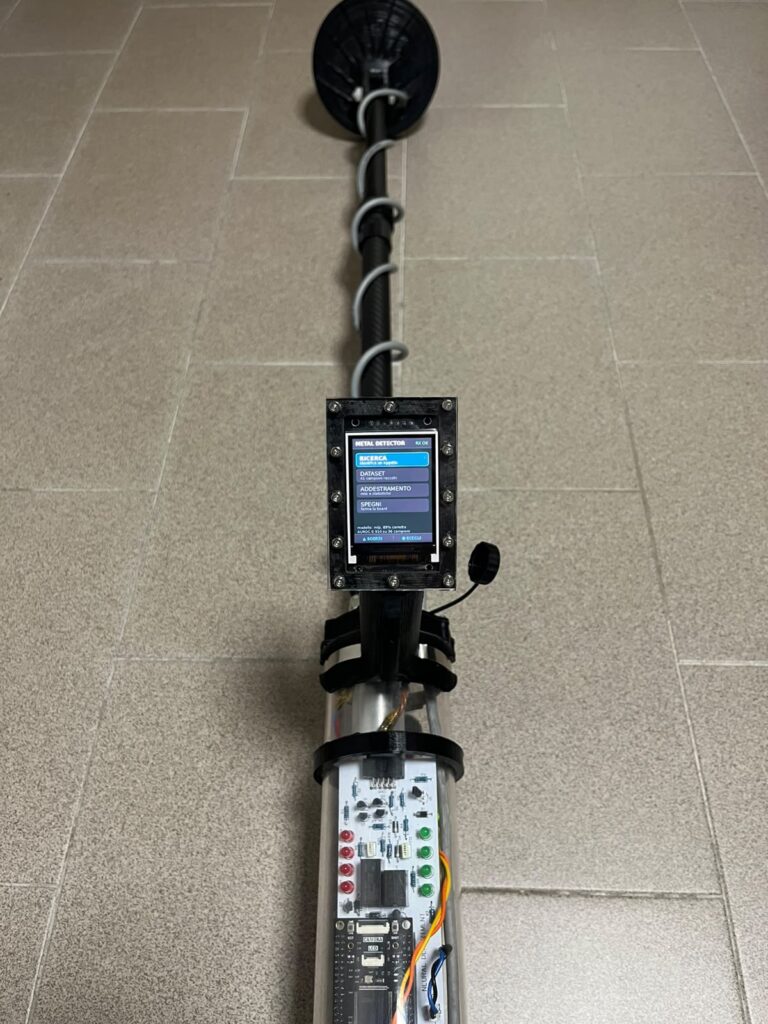
how you train it
- SEARCH — the machine measures and says what it thinks it is, as
percentages. - You dig, you see what it really was, and you save the acquisition with
the right label. - DATASET — the count of how many samples you have collected, by metal.
- TRAINING — the network is rebuilt from scratch on your samples. First
it tests itself by holding out one acquisition at a time and guessing it
with a network that has never seen it; then it shows you how well that
went and asks whether you want to keep the new model or throw it away. The
old one is never overwritten before you decide.
All of it on the shaft, with nothing plugged in.